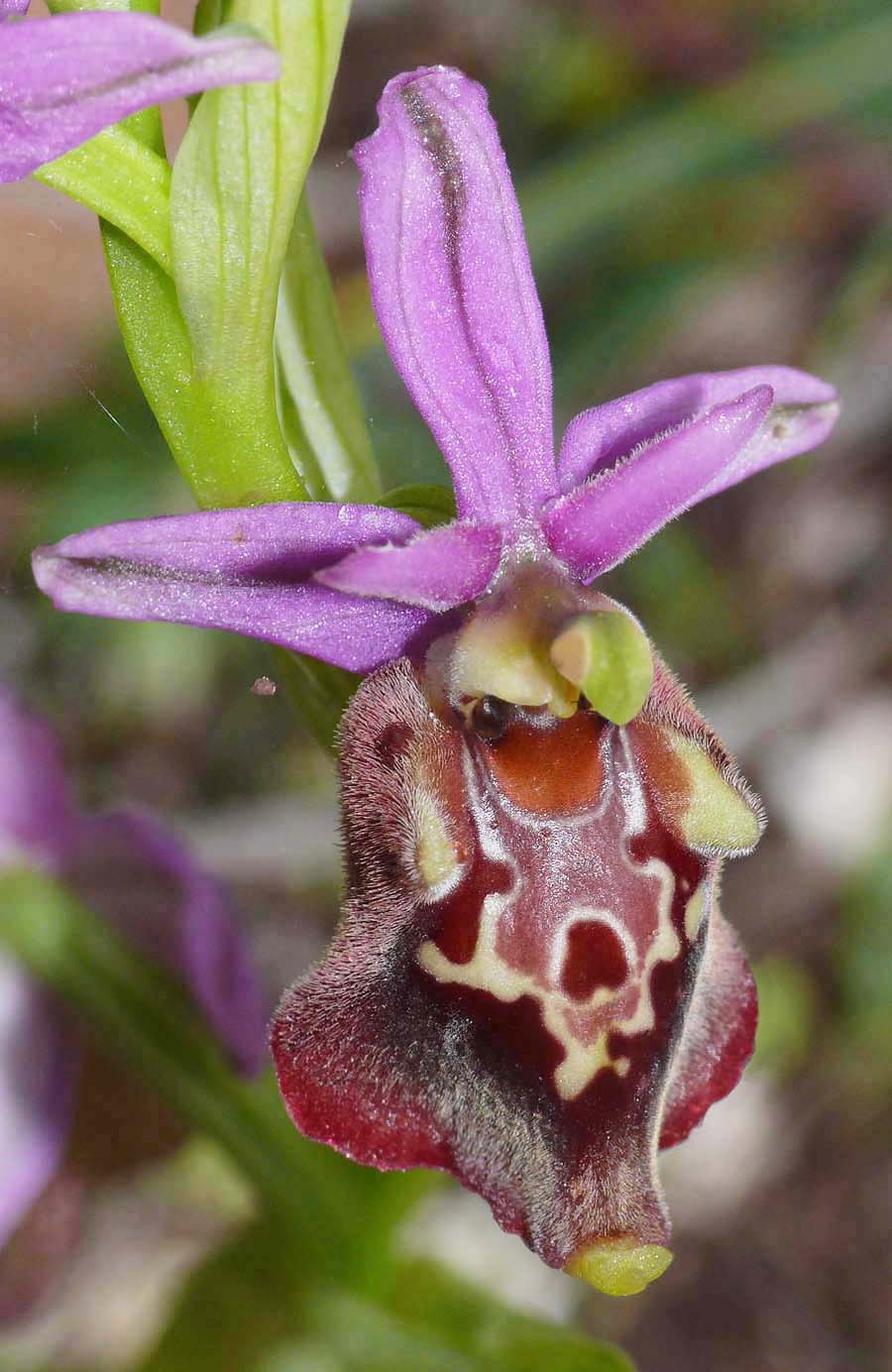
In
many ways the
most
interesting genus of European
orchids, these flowers that almost everyone
would
recognise as orchids, are renowned for their insect mimicry and many
are pollinated by specific insect species, duped into trying to
copulate with the flower. The flowers are very distinct
from other genera, with usually spreading sepals and petals that are quite
different from the sepals, the lip is frequentlycharacterised by its
insect-like appearance.
Ophrys has the largest number of European species of any genus with well
over
200
described by Delforge although some authors suggest way less
than
50 species and therein lies the problem, species identification !
The insect pseudocopulation mentioned above provides a most unusual
identification
characteristic
(studied by Charles Darwin) with different
species being defined by the insect species that mates with it !
It doesn't help when the pollinator is not in attendance and you are
just looking at the flowers .
We do not intend to argue the case for any particular approach other
than to say that recently we have used Delforge's book as our field
guide and it makes you look very carefully at plants
and
pick up small differences (unfortunately these often occur within a
single population of the same species), what you then call them is
really up to you.
W
herever we have been able to follow
Delforge's distinctions we have used his nomenclature on this site, if
only to be able to show more photos. However for many species
differences are often small and in practice you have to rely on factors
other than appearance (such as distribution, flowering time, etc) to
separate very similar plants. At the other extreme there is
often such variability within a single population of a given species to
suggest more than one species is present.