O. fusca
was first described from Lisbon, Portugal in 1800 and its name refers to the species dark labellum. This characteristic led to the orchid acquiring the common name of Dull or Sombre Ophrys.
This species, or perhaps more correctly the name, O. fusca, was the original plant from which, over the years, numerous subspecies have been identified and more recently, many new species described. The term O. fusca sl. is still in common use as an inclusive grouping that describes unidentified Pseudophrys of a similar appearance. O. fusca was originally thought to occur throughout the greater Mediterranean region but over the last twenty years, various studies and the recognition of numerous new species have led to the conclusion that its range is now restricted to a relatively small area of central Portugal.
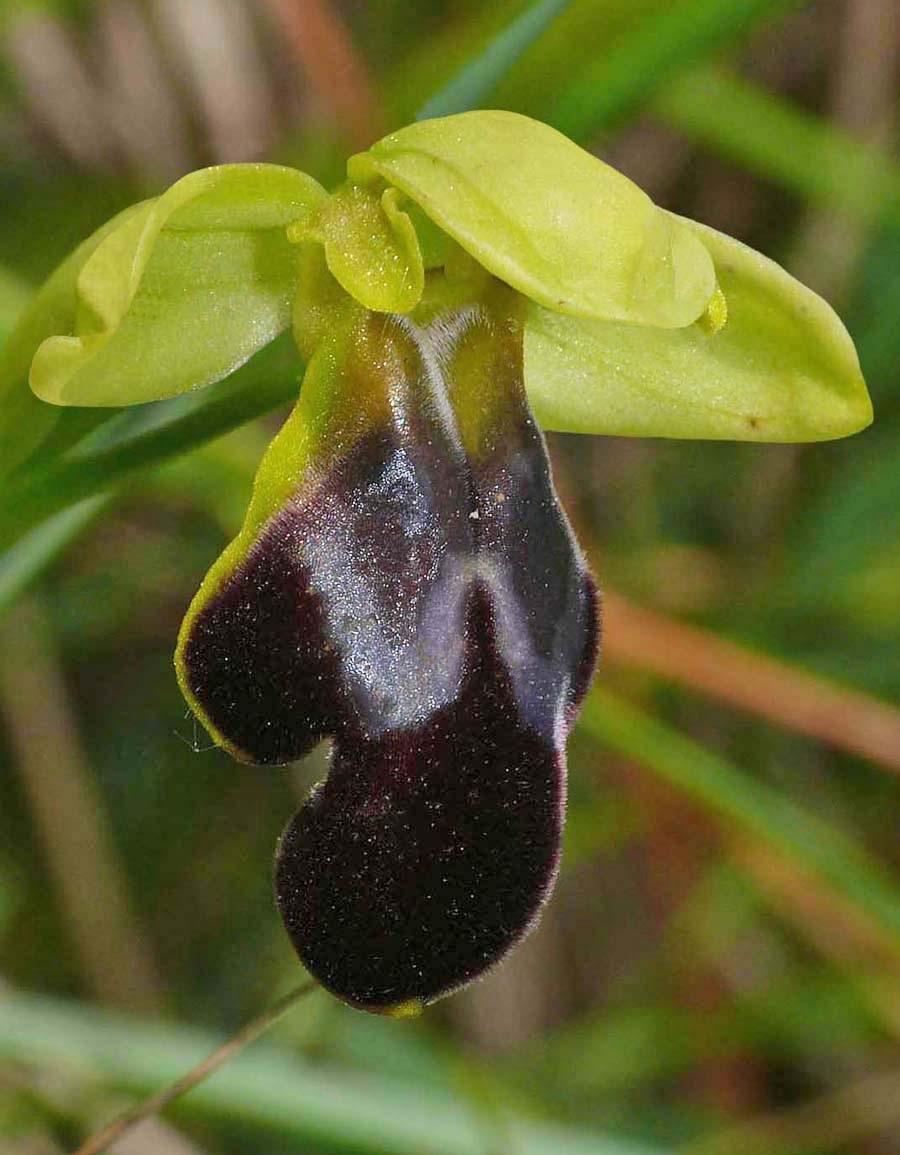
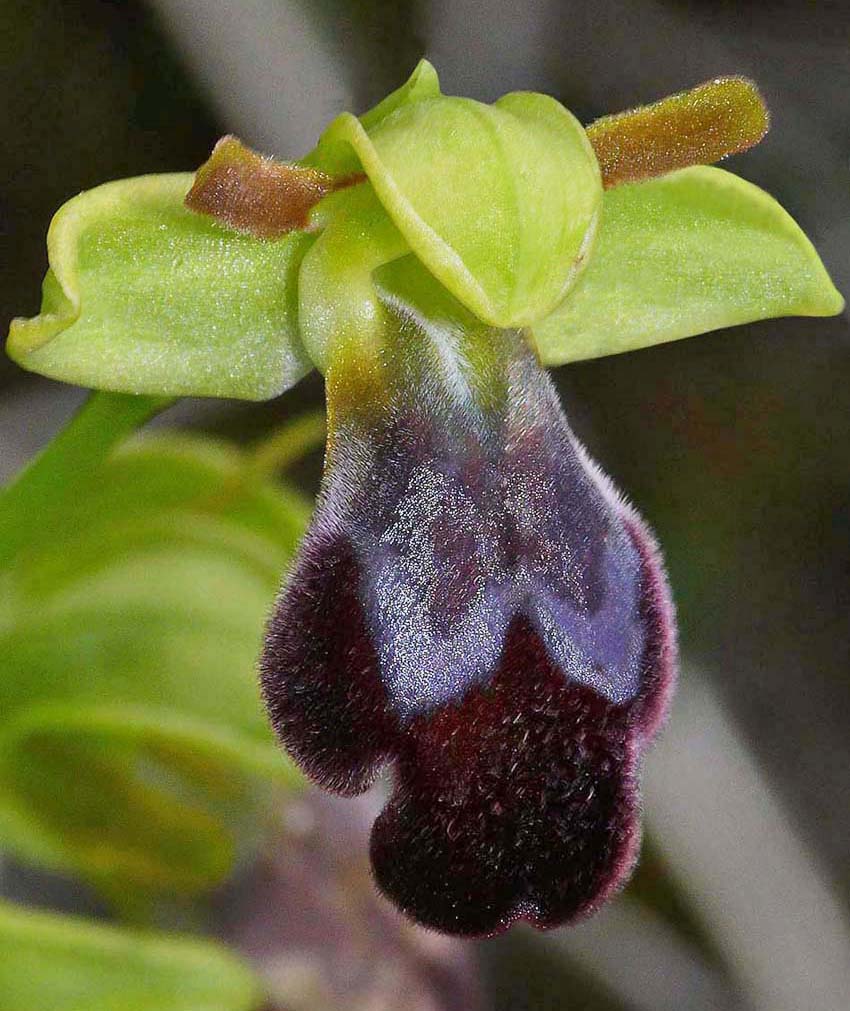
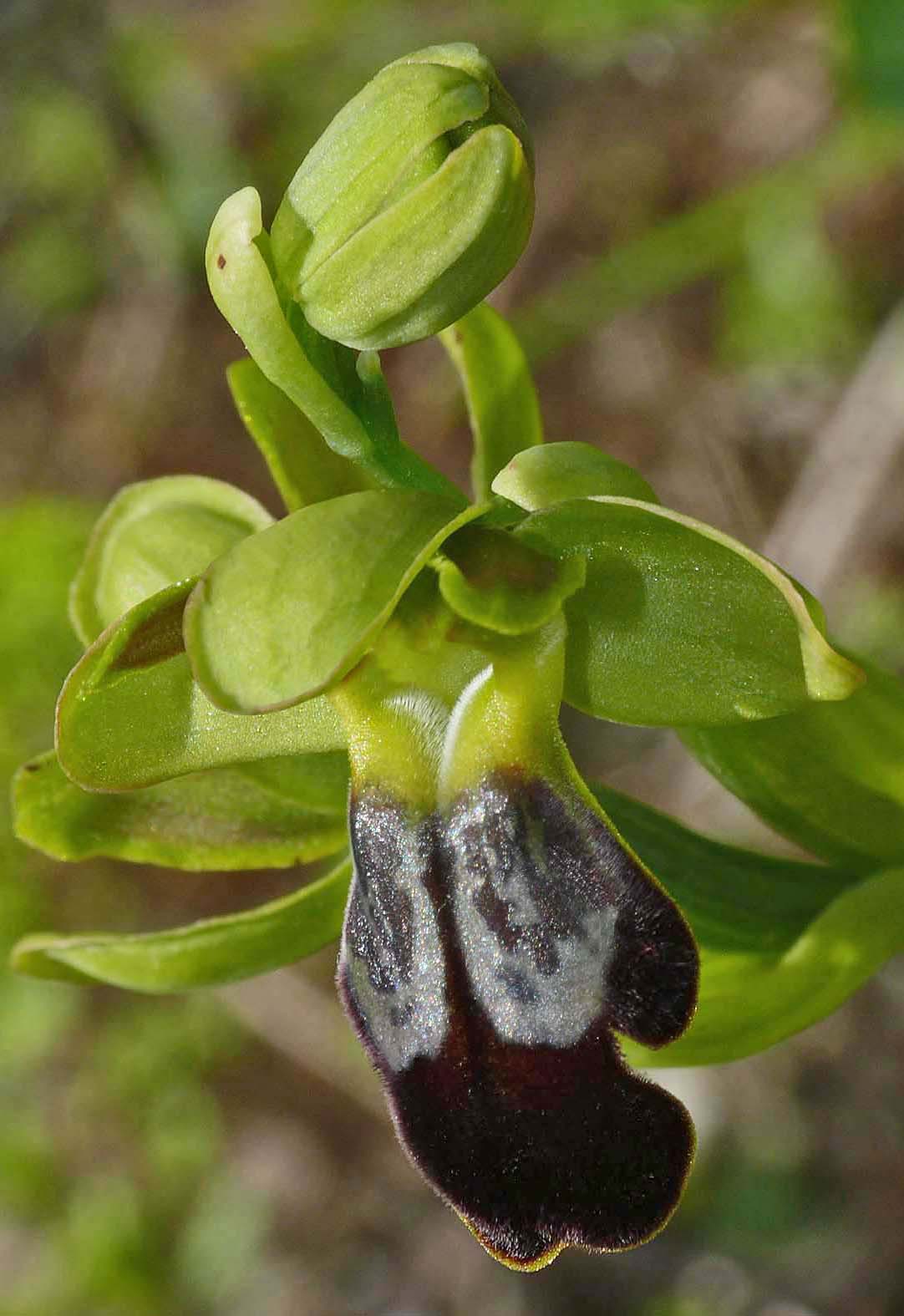
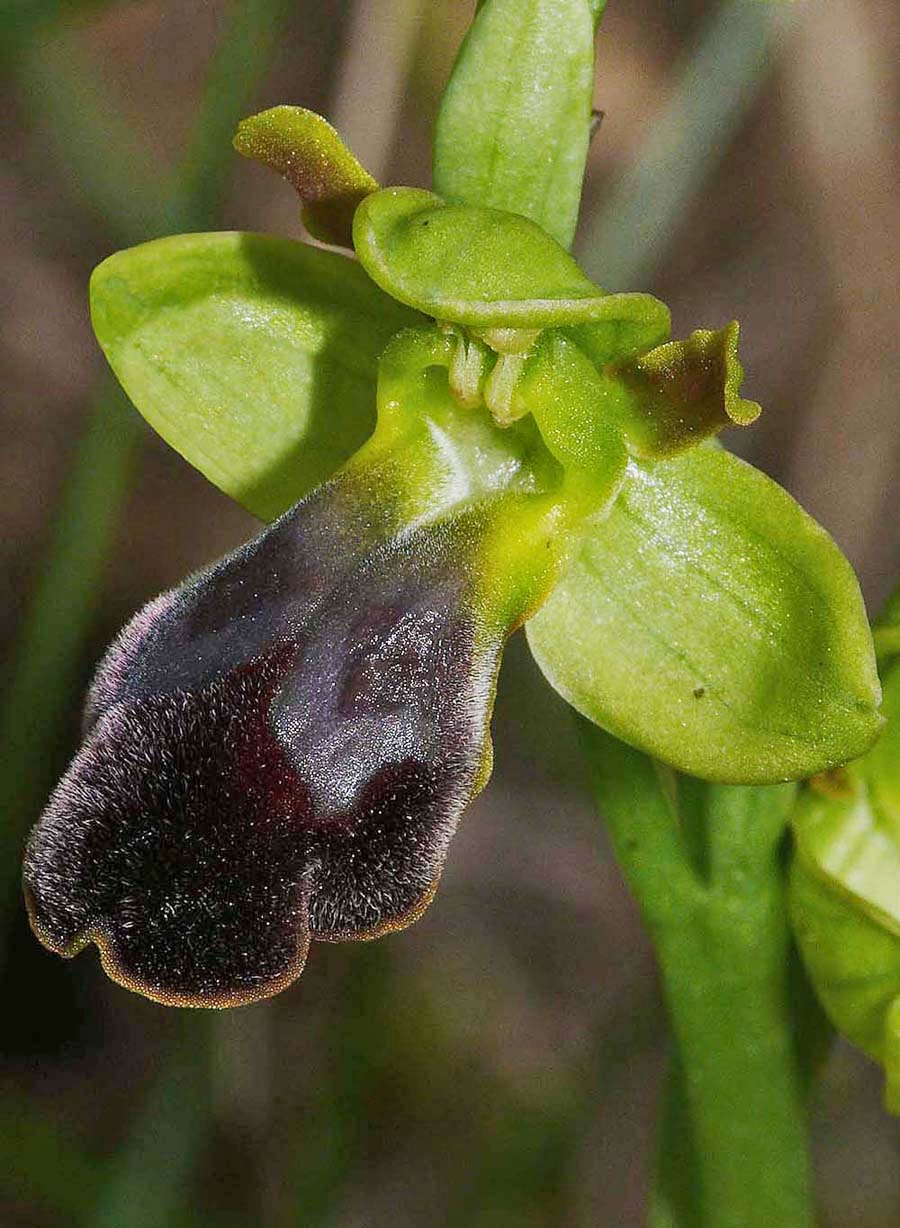
It is not particularly demanding in its choice of habitat but does show a preference for alkaline substrates, where it grows as a relatively tall plant with up to ten large flowers. It is most easily distinguished by its dark, blackish/purple colouration and by the large, raised longitudinal prominences and relatively shallow V shaped groove which attenuates just above the specular crescents. The lip is relatively flat but recurved at the distal end and usually exhibits a yellow or orange margin. The speculum is quite dull, being dark blue/grey, sometimes mottled, but sitting above prominent, shiny silver/blue crescents.
Accepting that O. fusca is indeed limited to this relatively small area of Portugal it really only encounters two similar Pseudophrys with which it can be confused. O. pintoi is a shorter plant with significantly smaller flowers and O. bilunulata which is similarly proportioned but easily distinguished, not least by its broad yellow lip margin.
This species, or perhaps more correctly the name, O. fusca, was the original plant from which, over the years, numerous subspecies have been identified and more recently, many new species described. The term O. fusca sl. is still in common use as an inclusive grouping that describes unidentified Pseudophrys of a similar appearance. O. fusca was originally thought to occur throughout the greater Mediterranean region but over the last twenty years, various studies and the recognition of numerous new species have led to the conclusion that its range is now restricted to a relatively small area of central Portugal.
It is not particularly demanding in its choice of habitat but does show a preference for alkaline substrates, where it grows as a relatively tall plant with up to ten large flowers. It is most easily distinguished by its dark, blackish/purple colouration and by the large, raised longitudinal prominences and relatively shallow V shaped groove which attenuates just above the specular crescents. The lip is relatively flat but recurved at the distal end and usually exhibits a yellow or orange margin. The speculum is quite dull, being dark blue/grey, sometimes mottled, but sitting above prominent, shiny silver/blue crescents.
Accepting that O. fusca is indeed limited to this relatively small area of Portugal it really only encounters two similar Pseudophrys with which it can be confused. O. pintoi is a shorter plant with significantly smaller flowers and O. bilunulata which is similarly proportioned but easily distinguished, not least by its broad yellow lip margin.